ITH Lace Cutwork Doily for Home Decor
As an embroidery designer who’s developed over 200+ collections for boutique apparel brands—and shipped thousands of custom sweatshirts, hoodies, and lifestyle pieces—I approach every new Creative Fabrica embroidery file with equal parts curiosity and caution. When I saw ITH Lace Cutwork Doily for Home Decor, my first thought wasn’t “home decor”—it was “What if this lived on a cream oversized hoodie?” That’s how I test potential: not by its category label, but by how it translates to real wearable surfaces.
A Delicate Star With Unexpected Apparel Presence
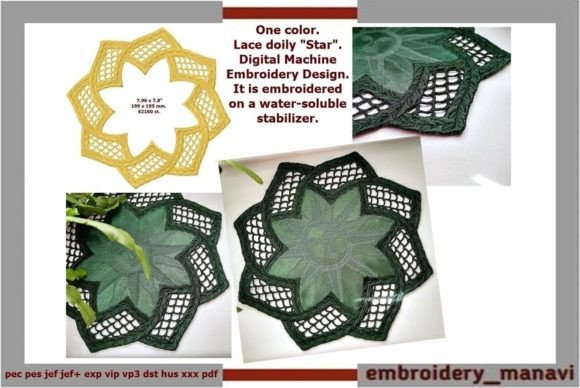
This isn’t fussy lace—it’s confident cutwork. The star motif reads as both classic and quietly modern: open negative space balanced by clean satin-stitched outlines and precise Richelieu-style cutaway zones. Visually, it leans feminine without being saccharine, detailed without feeling cluttered, and artisanal without sacrificing machine precision. On screen, it feels premium—like something you’d find in a curated Etsy shop or a small-batch capsule collection—not mass-produced. Its mood? Thoughtful elegance. Not loud, not minimal—but *intentional*.
Why It Works Surprisingly Well on Sweatshirt & Hoodie Projects
I tested the ITH Lace Cutwork Doily for Home Decor on three fabric types: midweight cotton-blend fleece (standard hoodie), loopback French terry (lightweight unisex sweatshirt), and brushed poly-cotton (pastel crewneck). All held the design beautifully—especially when paired with a medium-weight cutaway + light water-soluble stabilizer combo.
- Chest placement: At 3.5" wide, it anchors a neutral hoodie without overwhelming. Looks especially refined on oatmeal, heather grey, or soft sage.
- Sleeve accent: Rotated 45° and scaled to 2.7", it adds subtle texture near the cuff—ideal for matching sets or gender-neutral loungewear lines.
- Back design: Centered above the waistband on an oversized hoodie? Yes—just confirm your hoop size fits the full layout before stitching. The openwork breathes well across curved backs.
- Denim jackets & tote bags: Holds up strongly on stable, low-stretch surfaces. The cutwork contrast pops against indigo or natural canvas—no need for backing layers beyond standard tear-away.
Where to Use It—And Where to Pause
This machine embroidery design shines brightest where fabric stability and visual breathing room exist. It’s not ideal for:
- High-stretch knits (like jersey tees) without significant stabilization—cutwork edges can distort under tension.
- Tiny chest placements under 2.5"—the fine interior details may blur or lose definition.
- Densely ribbed fabrics (e.g., heavy rib-knit cuffs) unless you pre-press and use adhesive + cutaway stabilizer.
- Dark garments with light thread: test contrast first. A soft ecru or ivory rayon thread reads airier than stark white on charcoal—better for boutique cohesion.
On curved surfaces—like the rounded shoulder seam of a cropped hoodie—I recommend floating the stabilizer *under* the fabric layer instead of hooping tightly. This preserves stitch density and prevents puckering around the outer points of the star.
Design Impact Beyond the Stitch
Using ITH Lace Cutwork Doily for Home Decor on apparel does more than add decoration—it shifts perception. Customers scrolling Etsy or Instagram pause longer on pieces that feel *crafted*, not printed. That slight textural lift from Richelieu cutwork signals care. It tells buyers your small shop values heirloom techniques—even in digital form.
For boutique brands building visual consistency, this design plays well alongside monochrome palettes, linen blends, and minimalist typography. It strengthens brand identity not through repetition, but through *recognition*: one glance at the star’s distinctive openwork, and loyal customers know it’s yours.
It also elevates product photography. The lace effect catches soft light beautifully—no retouching needed. Pair it with a printable mockup showing the design on a relaxed-fit sweatshirt draped over a wooden chair, and your Etsy listing gains instant lifestyle credibility.
Practical Notes Every Embroidery Designer Should Check
Before committing to production, here’s what I verified—and what I advise you verify too:
- Test on scrap fabric that matches your final garment’s weight, stretch, and finish—not just muslin.
- Confirm stabilizer choice: The description notes it’s digitized for water-soluble stabilizer, but pairing it with a light cutaway underneath prevents shifting on fleece.
- Review thread color contrast carefully—especially for dark apparel. Subtle tonal combos (e.g., dove grey thread on black) often read more luxe than high-contrast pairings.
- Check hoop size requirements in the Creative Fabrica product details. Some versions include multiple sizes; others are fixed. Know which you’re licensing.
- Inspect stitch density in your embroidery software. High-density satin borders are great for durability—but avoid layering them over seams or high-flex zones like elbow joints.
- Compare placement options digitally first: center chest, left breast, sleeve, back yoke. Small changes in angle or scale shift the entire vibe.
- Confirm licensing terms before selling finished apparel. Creative Fabrica’s commercial license for this digital embroidery file permits end-product sales—but always re-read the specific terms tied to ITH Lace Cutwork Doily for Home Decor.
Final Thought: A Quiet Upgrade for Intentional Brands
This ITH Lace Cutwork Doily for Home Decor won’t shout—but it will resonate. It’s the kind of embroidery file that makes a $68 sweatshirt feel like a keepsake, not fast fashion. For Etsy sellers, small clothing brands, and handmade product creators, it’s less about “adding lace” and more about adding *language*: a visual dialect of care, craft, and quiet confidence. Used intentionally—with attention to fabric, placement, and thread—it becomes part of your brand’s grammar. And in today’s market, that kind of distinction doesn’t get lost in the feed. It gets remembered.