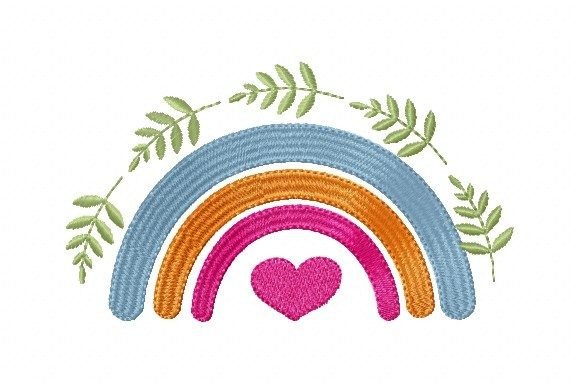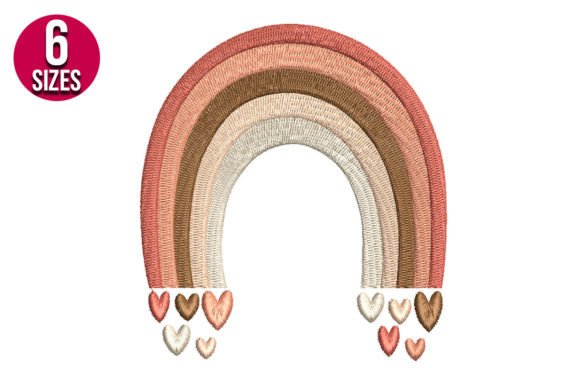
Boho Rainbow with Hearts
First Impression: Joyful, Approachable, and Instantly Recognizable
As an embroidery designer who’s curated over 200 craft fair booths in the past decade, my gut reaction to Boho Rainbow with Hearts is immediate: it’s joyful without being childish, boho without leaning into cliché, and graphic enough to pop on a crowded market table. It doesn’t feel rustic or farmhouse—it leans modern boho, with soft curves, balanced spacing, and a warm, inclusive energy. That matters. At a craft fair, customers scan your booth in under three seconds. Boho Rainbow with Hearts earns that glance—and holds it.
Where It Shines: Craft Fair Product Placement That Converts
This machine embroidery design thrives where personality meets utility. On tote bag designs, it anchors the front panel beautifully—large enough to read from six feet away, yet delicate enough not to overwhelm canvas or linen. As apron embroidery, it works best centered above the pocket or subtly tucked along the waistband, adding charm without competing with function. For tea towel embroidery, it performs best on lighter-weight cotton or linen blends; avoid heavy terry or looped textures unless you adjust stabilizer and stitch density. On curved surfaces like caps, test placement early—the heart details and rainbow arcs must remain legible across the dome.
Embroidered patches are where Boho Rainbow with Hearts truly excels as a small shop product. Its clean outlines and moderate fill areas translate reliably at 2.5"–3.5", making it ideal for iron-on or sew-on patches sold individually or bundled with pins and stickers. Likewise, on fabric pouches and pillow covers, it reads clearly at mid-scale (4"–5") and pairs effortlessly with neutral or earth-toned fabrics—no clashing, no visual fatigue.
Online & Digital Performance: From Etsy Listings to Printable Mockups
For the Etsy seller or digital embroidery business owner, Boho Rainbow with Hearts is a strong visual asset. It photographs cleanly against white or sage backdrops, and its color-blocking nature makes it easy to showcase multiple thread color variations in one listing. When used in printable mockups, it scales well across devices—no pixelation, no loss of shape integrity. As a digital embroidery file, its inclusion of multiple formats means broader software compatibility, which reduces customer support requests and increases trust in your shop.
That said—don’t assume it’s “set and forget.” Always generate at least one real-world commercial embroidery sample before listing. A mockup can’t replicate how dense stitch areas behave on textured towels or how tiny hearts render on dark fabric. Those details define perceived handmade quality.
Production Realities: What Makes This Design Sell—And What Requires Care
Boho Rainbow with Hearts is highly repeatable for batch production, thanks to its symmetrical balance and consistent line weight. It’s neither overly dense nor excessively sparse—meaning fewer thread breaks, smoother hooping, and faster run times across machines. That directly supports booth efficiency: you can embroider 12 tea towels in under two hours, then pivot to tote bags without re-threading or re-hooping stress.
But caution points exist. The hearts—especially if nested within rainbow bands—can suffer detail loss below 1.75". Avoid using Boho Rainbow with Hearts as a subtle accent on cuffs or collar tips unless you’ve verified clarity at that scale. Also, thick fabric (like denim or double-layered canvas) may mute fine curves. And on dark fabric? Prioritize high-contrast thread colors—off-white or pale gold instead of cream, mint instead of seafoam—to preserve definition.
Booth Impact: How It Strengthens Your Handmade Product Line
In person, Boho Rainbow with Hearts elevates perceived value. It signals intentionality—not just “embroidered,” but *designed*. When paired with natural fibers and thoughtful packaging, it helps your handmade product stand apart from mass-produced alternatives. At a craft fair, I place items featuring this design near the front edge of my table: embroidered pouches stacked beside matching pillow covers, a rainbow-adorned apron draped over a stool. It creates rhythm, warmth, and cohesion—key drivers of buyer engagement.
It also reinforces brand consistency for boutique makers. If your shop leans into soft palettes, mindful messaging, or inclusive aesthetics, Boho Rainbow with Hearts extends that voice without needing words. Customers remember how it made them feel—not just what it says.
Designer Notes You Can’t Skip Before Production
- Test on scrap fabric first—especially if using textured towels, caps, or dark substrates.
- Check thread contrast across at least three fabric colors (light, medium, dark) before finalizing your product lineup.
- Review spacing and stitch density in your embroidery software—look for overlapping fills or tight corners that may cause puckering.
- Confirm hoop size compatibility with your primary machine. If it pushes the edge of your standard hoop, consider simplifying or repositioning elements.
- Use the right stabilizer: cutaway for stretchy knits, tear-away for stable wovens, and heavy-duty cutaway for thick or textured surfaces.
- Create at least one real mockup—not digital, not printed, but stitched, pressed, and styled as a finished product.
- Compare fabric colors in natural light, not just under booth lighting—what looks vibrant indoors may dull outdoors.
- Confirm commercial licensing before selling finished products. This applies whether you’re selling embroidered patches wholesale or bundling the design with kits.
Final Thought: A Reliable, Uplifting Anchor for Your Creative Business
Boho Rainbow with Hearts isn’t just another embroidery file—it’s a versatile, emotionally resonant design asset. It bridges online appeal and in-person charm, supports scalable production, and fits naturally into multiple product categories without diluting your voice. For the craft fair seller, the small shop product creator, or the creative entrepreneur building a cohesive line, it’s less about trend-chasing and more about offering something that feels both timeless and tender. Done right—with attention to fabric, thread, and intention—it doesn’t just sell. It starts conversations. And that’s where real handmade connection begins.